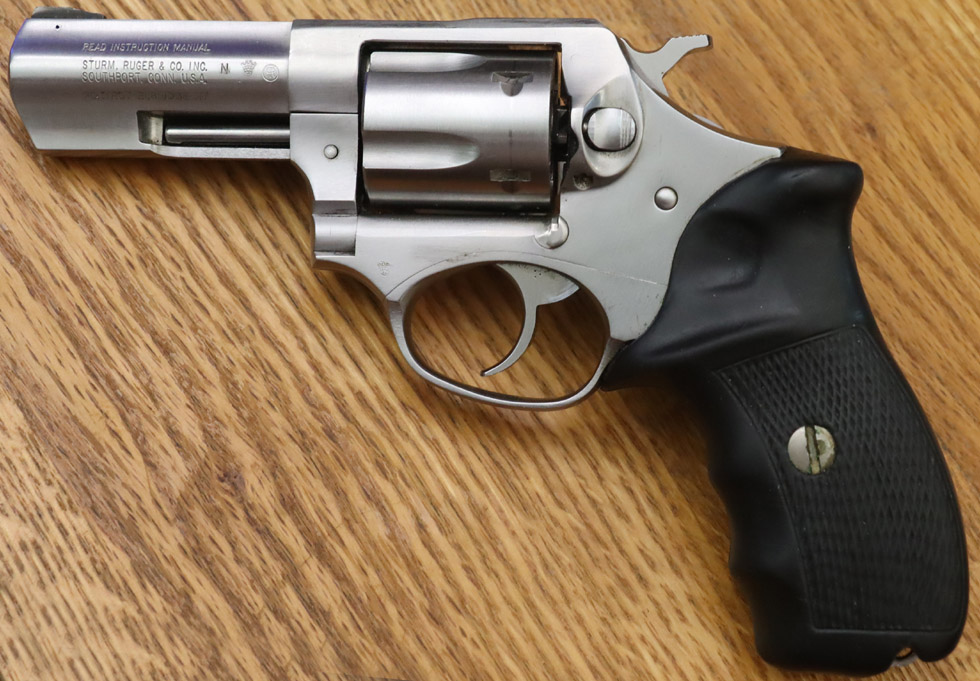
Ruger SP101
| Dimensions | Barrel Length | Weight | Caliber | Action Type | Magazine Capacity |
| 5.5" x 7.75" |
3" |
27 oz |
.38 Special |
DA/SA Revolver |
5 |
 this
class of revolver. This model is available in barrels from
2" to 4" and is offered in 357, 38, 327, 9mm, and 22
calibers. This is an
all stainless steel revolver with a solid frame that has
no side-plate. It has fixed sights, and for safety a
frame mounted firing pin and transfer bar. The barrel
has a full underlug in the style of the old Colt double
action revolvers.The muzzle is flat with a recessed
crown, but the rib and underlug are radiused, almost in
the style of the old Detective Special.
this
class of revolver. This model is available in barrels from
2" to 4" and is offered in 357, 38, 327, 9mm, and 22
calibers. This is an
all stainless steel revolver with a solid frame that has
no side-plate. It has fixed sights, and for safety a
frame mounted firing pin and transfer bar. The barrel
has a full underlug in the style of the old Colt double
action revolvers.The muzzle is flat with a recessed
crown, but the rib and underlug are radiused, almost in
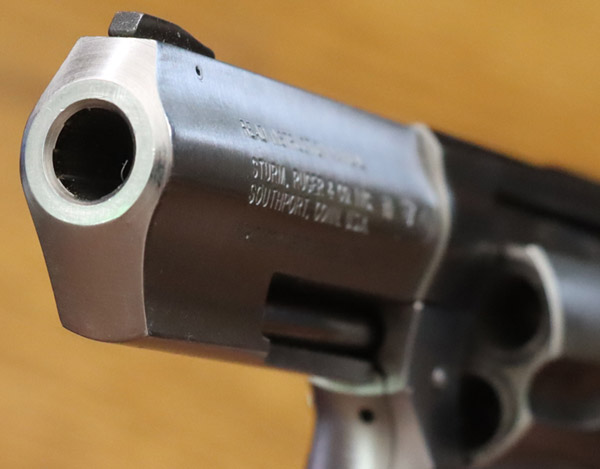
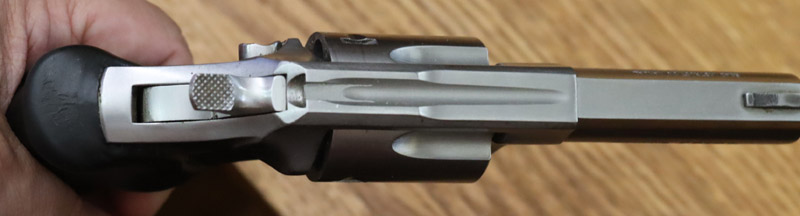
the style of the old Detective Special. The trigger is smooth and curved, and the hammer is nicely and sharply crosshatched in a non-slip pattern. Trigger pull on my example is around twelve pounds in double action, and around four pounds in single action. Double action is very smooth with no stacking that I could notice. Single action is really crisp without a trace of creep.
My particular example is in 38 Special with a 3" barrel, making it a semi snub with a five shot cylinder. The size and weight put it in between a classic small frame and medium frame. Ruger calls it a small frame, but I look at it as a very nice medium frame. What puts it over the top for me is the 3" barrel, rather than 2", and the full size grips, along with the rib and full lug under the barrel. These combine to make it just a hair too big for me to consider as a concealment snub nose. I would classify it as a compact, rather than a small frame revolver.
I am a sucker for a stainless gun. No worry about rust or wear, simplified care, and no need to be concerned with chemicals or oils in the holster. I also like the looks. Other things I like about the gun are the sights and the trigger. Single action or double action, the trigger is great. The fixed sights, though simple, are quite nice and easy to use. The grips give a solid secure feel, are quite comfortable and assist with natural pointing.
 These guns come from the factory with smaller rubber
grips featuring a wood or decorative insert. This
particular gun features Trausch grips. Please note the cut out at the
bottom of the grip for the lanyard ring. Trausch grips are made in France,
have a reputation for being very comfortable (mine are),
and are of non skid rubber. These are larger than the
grips normally found on this gun, and turn it into a
definite small holster gun, rather than any kind of
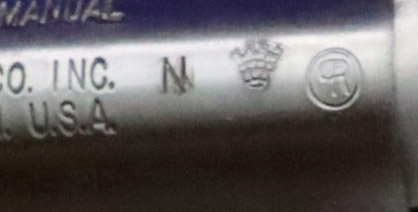
concealment gun. In addition to the Trausch grips, I notice French proof marks on the barrel.
More on that, later.
These guns come from the factory with smaller rubber
grips featuring a wood or decorative insert. This
particular gun features Trausch grips. Please note the cut out at the
bottom of the grip for the lanyard ring. Trausch grips are made in France,
have a reputation for being very comfortable (mine are),
and are of non skid rubber. These are larger than the
grips normally found on this gun, and turn it into a
definite small holster gun, rather than any kind of
concealment gun. In addition to the Trausch grips, I notice French proof marks on the barrel.
More on that, later. I admit, I would have preferred a 38/357 chambering. But 38 isn't as bad as many people like to say. The venerable 38 Special is basically very
 similar to the
wildly trendy and popular 9mm. As a general rule, the 38
will have a somewhat heavier bullet driven at somewhat
lower velocity than its 9mm rival. The reason for the
chambering is that this was a law enforcement contract gun
originally exported to France, and then retired and
imported back into the United States.
similar to the
wildly trendy and popular 9mm. As a general rule, the 38
will have a somewhat heavier bullet driven at somewhat
lower velocity than its 9mm rival. The reason for the
chambering is that this was a law enforcement contract gun
originally exported to France, and then retired and
imported back into the United States.The regulations under which law enforcement in France must operate do not allow Magnum rounds. They also do not allow +P rounds, so this particular run of guns was not rated for +P. Certain French metro police departments are even more constrained, being limited to the 32.
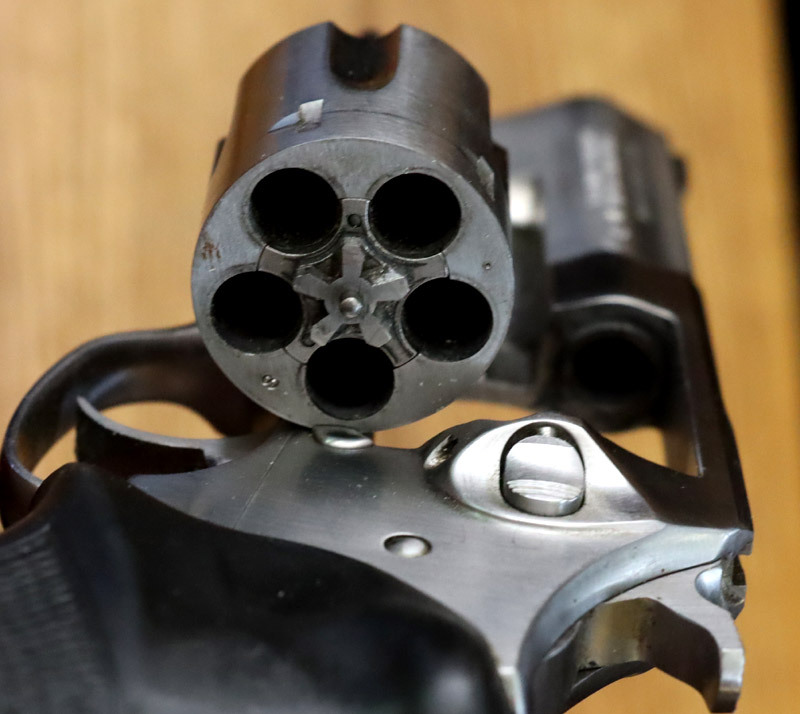
Despite not being rated for +P rounds, the chamber wall thickness of the five shot cylinder seems pretty generous. The cylinder has a diameter of 1.35" making it a bit wider than that of the S&W J-frame, but not quite as robust as that of the K-frame. So despite the wall thickness, this cylinder is not suitable for six shots in this caliber.
This gun is a pleasure to shoot. The very comfortable, if somewhat oversize, grips do a lot for the handling qualities. The use of the 38 Special in this size and weight of frame also make for easy shooting. The fixed sights are sharply defined, of good size, and feature a blue steel front blade, rather than a stainless front sight. These are all small touches, but add up to a nice shooting gun. The size, caliber, and stainless construction make this a great kit gun or knock-around gun.
I am no great marksman, but a relatively capable shooter. With this gun, af 15 feet, I can get all five rounds in the black of a standard target. Nothing spectacular, but good enough.
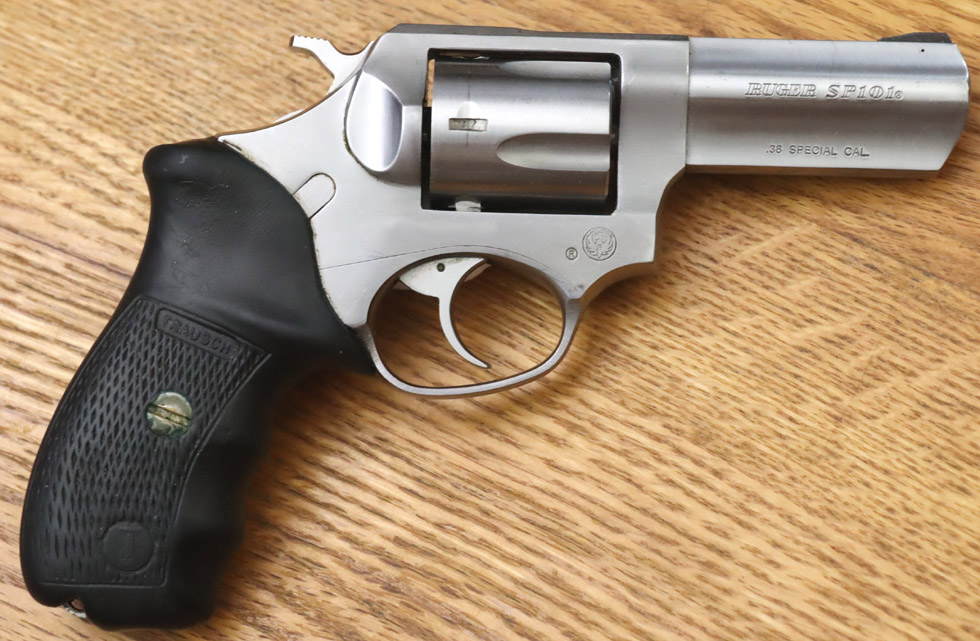
Trausch
Grips and Lanyard Ring
Those of you who are Ruger aficionados will note these
are not Ruger grips. The standard Ruger grip is quite a
bit smaller, and is of two piece 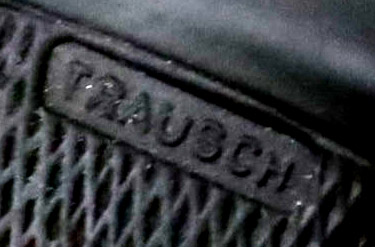 construction
usually with a wood or decorative insert. This gun, and
the rest of the export guns produced for this contract
were equipped with Trausch grips. These grips are quite
a bit larger than the standard Ruger grips, and have a
clumsy looking overhang, almost like a hunchback, at the
top of the grip. This gives the gun an odd almost
antiquated look.
construction
usually with a wood or decorative insert. This gun, and
the rest of the export guns produced for this contract
were equipped with Trausch grips. These grips are quite
a bit larger than the standard Ruger grips, and have a
clumsy looking overhang, almost like a hunchback, at the
top of the grip. This gives the gun an odd almost
antiquated look. These grips were designed by Jacques Trausch in the 1990's and bear his name. He was a well known competitive shooter, and was a firearms instructor for French law enforcement. The distinctive profile of these grips came from his experience in years of training and competitive shooting. Their production by his company ended in 2012 with his death. His heirs were not interested in continuing the line.
These grips are probably the reason I was able to buy this revolver. It sat in a case at a local gun shop for weeks before I finally made up my mind to purchase. The grips are not aesthetically pleasing to most shooters, and a revolver of this size in 38 with a five shot cylinder reduces it's appeal for defense and concealed carry. I understand this because I felt the same way, which is why it took me three weeks to make up my mind.
These polyurethane grips are quite soft and smooth feeling, even with the cross hatching, yet they do offer a firm grip. I suspect a multilayered construction with different densities of polyurethane. The curve and overhang at the top let the grip settle into the shooter's hand. The right hand side of the grip has a contour that fits the shooter's hand. The shape of the grip, that gives it such an odd look, makes it almost impossible to hold the gun incorrectly. These are probably some of the best revolver grips I have ever used.
It is surprising to me that someone hasn't started making knock offs of these. The Chapuis Arme company still makes these for it's elite Manurhin revolvers but they are $4000 - $5000 firearms imported by Beretta, and are in short supply. The grips are not offered for sale by themselves except as accessories or replacements for the MR73 revolver. They are also not produced to fit any other models.
In addition to the Trausch grips, this gun has a lanyard ring. I have a few other handguns with lanyard rings, but it is not a particularly common option, particularly on civilian firearms. A lanyard ring allows for the attachment of a lanyard, basically a tether. This can be a simple line run through the ring and then tied off, or a more elaborate braided line with a metal clip for quick attachment.
A lanyard has mixed utility. Those of us who attended gym class in school were taught by coaches who had whistles hanging from a lanyard around
 the neck, so
that the whistle would always be handy. Most jobs these
days require an ID badge which is often suspended from a
lanyard worn around the neck. sailors from as far back
as the age of sail, have attached lanyards to knives and
other tools so that they would not be in peril of being
dropped overboard during use.
the neck, so
that the whistle would always be handy. Most jobs these
days require an ID badge which is often suspended from a
lanyard worn around the neck. sailors from as far back
as the age of sail, have attached lanyards to knives and
other tools so that they would not be in peril of being
dropped overboard during use. For the military and police, a lanyard has all sorts of uses, many ceremonial. Functionally, a pistol lanyard may be attached to a belt, a holster, or an epaulet. Soldiers and law enforcement officers do not typically hang weapons from their necks. The pistol lanyard functions to retain possession of the pistol should it be dropped or should an attempt be made to steal it. This can be pretty useful in stressful encounters where a weapon my be fumbled or dropped, or where a user may fall or be knocked down. .
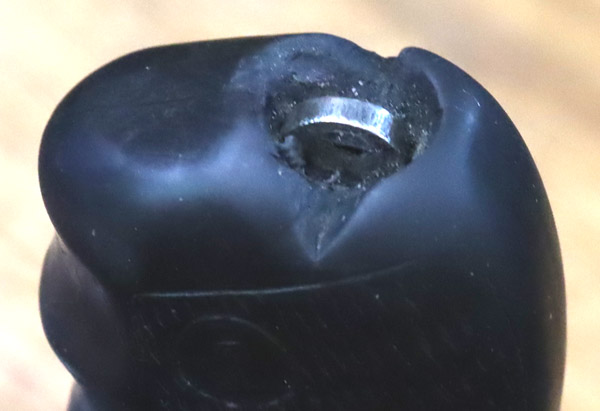
As can be seen from the photos, the installation of the lanyard ring was not particularly elegant. A flat piece of steel was measured to length, drilled with a hole, and pinned to the bottom of the frame. the lovely Trausch grips, which I have come to admire after having used them, then had a V shaped notch cut into them for the ring to protrude. The notch seems to have just been cut and gouged, and no finishing piece was added.
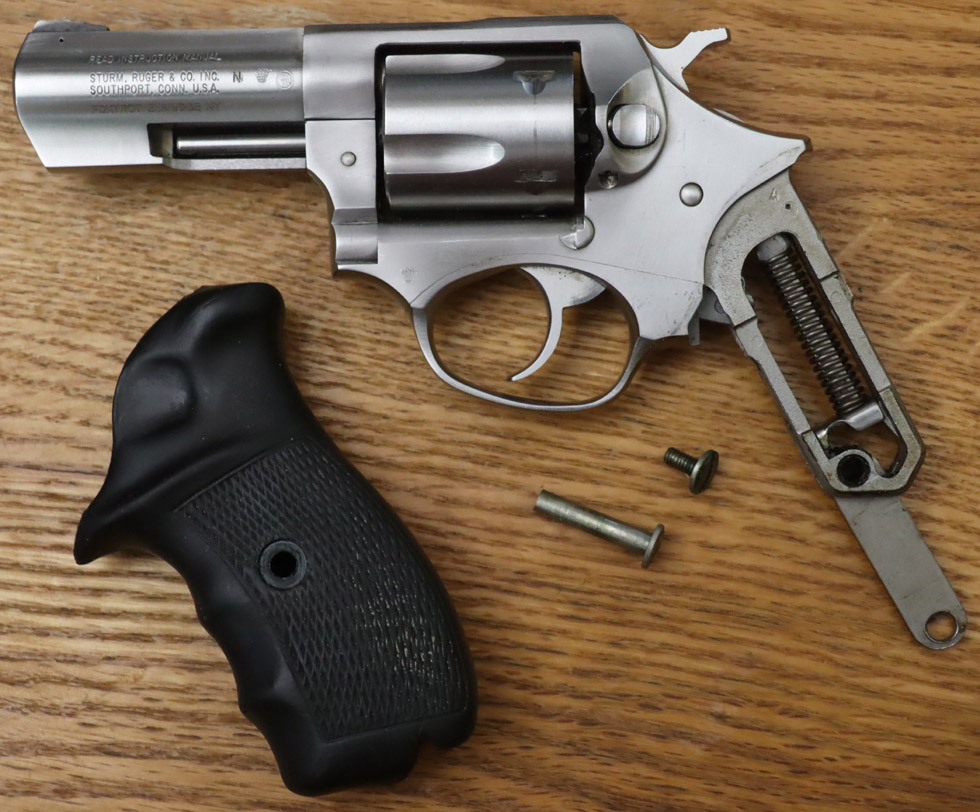
With the grips removed, it can be seen that the grips are quite large for the frame, and that the addition of the lanyard ring is quite a simple operation. It can also be noted that the grips do not use the original grip mounting hole, whcih is used by the lanyard ring. Instead, it is held on by friction and grip shape.
The
French Connection
 The things you discover on the web. This gun is
a used police surplus, which I knew when I bought it. I
assumed it was from some US police agency. What I did not
know was that it was from the French Railway Police. It is
38 only, and has a lanyard ring attached to the frame,
that goes through a hole in the grips, and then attaches
to the duty belt.. Ah... visions of the Orient Express,
the man with the red fez and pencil mustache sitting next
to the retired British colonel. Across from them sits a
quiet man with a briefcase full of stolen jewels, or is it
full of secret papers? At any rate, all board in Paris,
and are headed to Istanbul.
The things you discover on the web. This gun is
a used police surplus, which I knew when I bought it. I
assumed it was from some US police agency. What I did not
know was that it was from the French Railway Police. It is
38 only, and has a lanyard ring attached to the frame,
that goes through a hole in the grips, and then attaches
to the duty belt.. Ah... visions of the Orient Express,
the man with the red fez and pencil mustache sitting next
to the retired British colonel. Across from them sits a
quiet man with a briefcase full of stolen jewels, or is it
full of secret papers? At any rate, all board in Paris,
and are headed to Istanbul.Sadly, the French rail Police are a relatively new entity. They were formed in 2006 after numerous incidents involving young thugs. Previously, the various rail line had their own security forces.
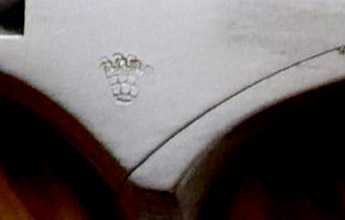
The St. Etienne proof mark is kind of neat. it looks like a little crown and dates back to 1897. There is one on the frame, just above and to the left of the trigger guard, and then another on the barrel next to a date code and an additional proof mark (probably an importer mark for bringing it back into the US). Proof marks are a historic study all their own.
 The combination of grips, barrel length, and chambering
make this kid of a unique gun. It also has a somewhat
shorter cylinder than current production guns. I have read
accounts indicating this is to enhance performance with 38
Special loads. I have heard other accounts advising that
the shorter cylinders were common on early production
runs. As the photos indicate, the cylinder fits almost
exactly within the cutout in the frame.
The combination of grips, barrel length, and chambering
make this kid of a unique gun. It also has a somewhat
shorter cylinder than current production guns. I have read
accounts indicating this is to enhance performance with 38
Special loads. I have heard other accounts advising that
the shorter cylinders were common on early production
runs. As the photos indicate, the cylinder fits almost
exactly within the cutout in the frame. Interesting how the guns were deployed. I grabbed a stock photo of the French rail Police from the period when these guns were being issued. Note the lanyards and duty belt holsters. These were not issued as concealed arms, but were simply small and light issue duty pistols, for the officer who found himself spending much of the day walking. I can see this becoming a great kit gun, daily carry piece, or knock around gun. Now if only I could get one of those snazzy white belts and holsters. Very fashionable in the way that only the French can be.

Why the 38?
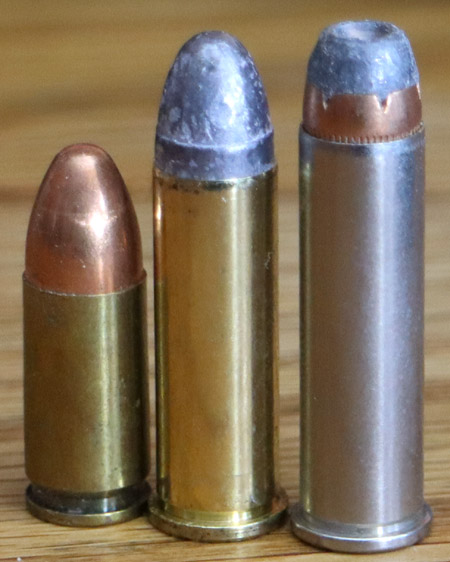 What is it about the 38 Special? This round was developed
over a century ago, back in the days of black powder. Its
original load was of 21 grains of black power under a 158
grain lead slug. At the time of its introduction, it was a
cutting edge cartridge, meant for use in the newly developed
cutting edge swing out double action revolvers that
dominated law enforcement for most of the last century.
What is it about the 38 Special? This round was developed
over a century ago, back in the days of black powder. Its
original load was of 21 grains of black power under a 158
grain lead slug. At the time of its introduction, it was a
cutting edge cartridge, meant for use in the newly developed
cutting edge swing out double action revolvers that
dominated law enforcement for most of the last century. Today, less than 5 grains of modern powder will do the same job as the original 21 rains of black powder, so the case really is much longer than it needs to be for modern smokeless powders. This realization was what inspired development of the 357 Magnum. Modern powders and metals are also the reason the case of the ballistically very similar 9mm is so much shorter.
For decades, the combination of 38 Special in a swing out double action revolver was THE way for the modern police officer or military man, not to mention armed citizen, to be armed. As things got uglier, law enforcement started to go with Plus P rounds, then the 357 Magnum. Eventually, American law enforcement largely abandoned the revolver altogether, and went with high capacity semi automatics on 9mm. Though loads vary, in general, the 9mm fires a somewhat lighter bullet at a slightly higher velocity.
The demise of the 38 has been predicted for decades, since the advent of the Wonder Nine style of semi auto pistol, and their large scale adoption by law enforcement.Yet this has failed to occur. Though the 38 no longer dominates the field as it once did, it still has a place, particularly for the casually armed civilian.
One big advantage to this cartridge, when compared to the popular 9mm, is its chambering in revolvers, particularly small light revolvers. This may not seem like an advantage at first look, when you consider the many high capacity revolvers out there with their many safety and sighting features, but there are advantaged to revolvers, even today.
Auto-loading handguns can be complex devices. I have had semi automatic handguns jam, misfire, or fail to feed. I have had issues with safeties, particularly grip safeties and magazine safeties. I have heard of shooters, under pressure, accidentally hitting the magazine release and ejecting loaded magazines from their guns. Such things do not happen with revolvers.
There are some revolvers that have been designed to fire the 9mm, but these tend to use either a loading device like a half moon of full moon clip, or have rather complex ejector systems to adapt the revolver to the rimless design of the 9mm cartridge. easier to simple chamber for the 38.
Another option to consider would be the 357 Magnum, which is used in many modern revolvers. The 357 was developed in the thirties to take full advantage of the newer metals and powders then available. It is slightly longer than the 38 Special, but this is only to prevent chambering in older guns. It is possible to load a 38 special to the same pressures, velocities, and energies as a 357. For a small gun with a shorter barrel, the 357 is unsuitable. In addition to the increase in recoil, much of the velocity of the 357 requires a slower powder and longer barrel, so the cartridge is just wasted in the short barreled guns.
A compromise between 38 and 357 is somewhat realized in the loading of the .38 +P round. Though not precisely defined, in general a +P round has an extra 10% energy when compared to a standard round. Unfortunately, this revolver is not rated for +P, which is surprising considering the thick walled five shot cylinder, and the availability of the same model chambered for 357.